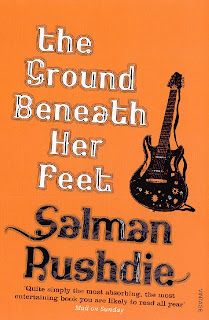
Sometimes prejudice can harbinger delight and surprise. I began reading The Ground Beneath Her Feet to find reasons to dislike Rushdie but by the end I am glad I found out why Rushdie deserves the hype that surrounds him.
The Ground Beneath Her Feet is indeed a work of great art though, with visible fault lines. The novel works on epic proportions. The Orpheus-Eurydice myth is culled into modern set up of pop-stars but that’s to say the least.
Rushdie is a great prose –stylist. He works carefully to create a pattern of life. Sometimes though, especially in the first half, the seams of his workmanship are visible. The art does not look effortless. Also restraint is not one of his gifts, at least not in this book. So the narrative gets cumbersome and repetitive and characters begin to look like caricatures. But he makes up for these flaws eventually.
His characters which at one time are exposed to the risk of appearing stock-types, emerge as strong and causative elements in the novel. He throws into the arena a Greek-God-style hero (Ormus), a modern-style anti-hero (Vina) and a single-man chorus (Umeed). The result is marvelous. Ormus has the gift of foresight and vision of the other-world while Vina has the sheer force of her personality and talent. Amind these two greats, Umeed hangs on to his human desires.
Love and art are the two main chords that run through the novel. The writer himself seems to be in the process of discovery in these two matters. He keeps conclusions open. The Ormus-Vina love has all that goes into being great, yet the author allows himself to question, almost mock this greatness.
Aloud I say, You know Vina, I don’t really get it. I never have. The way you two are together. How does that work exactly.?
She laughs. Higher love, she answers. Love on a higher level. Just think of it like that. Like exaltation.
Sexuality is a key element in the relationships throughout the novel. While Ormus, maintains a ‘purity’ by not taking any partners other than Vina, she on the other hand refuses to be bound to one and is open about it. Rushdie comes very close to creating the real life pop celebrities of genius, controversies and trademark eccentricities. Vina reverses the man-woman equation:
We, Ormus and I, we were her women: he , the loyal wife standing by her philandering husband, settling for him in spite of his roving eye, his wanderlust; and I, the simultaneous wanton and long-suffering mistress, taking what I could get.
Sexuality is inextricably mingled with love. The story muses about the perfect recipe for love but leaves the puzzled unsolved. On a similar note the 'art and virtuosity' equation is explored. After the final exit of Vina it seems impossible that she can be replaced as Ormus’ muse, but Rushdie dares to replace her with Mira, perhaps indicating a continuity in art irrespective of individuals involved.
One can point to number climaxes in the novel, which contributes to the sense of constant build-up and pace. One of the most surprising climaxes is where a raving Ormus, unable to accept the death of, Vina suddenly declares the advent of new in the form of Mira after the first concert.
“Vina Apsara? Oh, I’m sorry she died.”
For this moment it seems art is bigger than love, however, Rushdie drives carefully between the narrative and allows Ormus to fade for love though his art is shown to be finally free of Vina.
Rushdie brews his magic-realism on a recipe far different from that of Marquez. While Marquez’s magic slips in quietly, inconspicuous even to the reader, Rushdie makes magic as visible and baffling as in real life. However a reader would relate more to Marquez’s characters than that of Rushdie’s. Rushdie’s world is populated by unusual, curious characters. Yet gifted and surrounded by unusual, their fate is compelling and involving.


